How a Band of Builders Wove the Winds of Mondstadt into Blocks
The Skyblock Squad brings Mondstadt from Genshin Impact to life in Minecraft, blending artistry and devotion into a stunning 1:1 replica.
I remember the first time I set foot in Mondstadt—its cobbled streets humming with the sound of lyres, its great windmills turning slowly like the hands of a god counting the hours. There’s a peculiar kind of longing that a place like that can plant in you, a desire to carry a fragment of that freedom back with you, to hold it in your hands when the real world grows weary. For most of us, that longing stays latent, a half-remembered melody. But for a group of dreamers tucked away in Germany, it became a calling—a four-hundred-hour odyssey to resurrect the City of Freedom not in memory, but in block and stone, deep within the infinite canvas of Minecraft. As a fellow wanderer in both Teyvat and the Overworld, I watched their work unfold, and I can tell you that what they built is less a replica and more a poem translated into a new language.
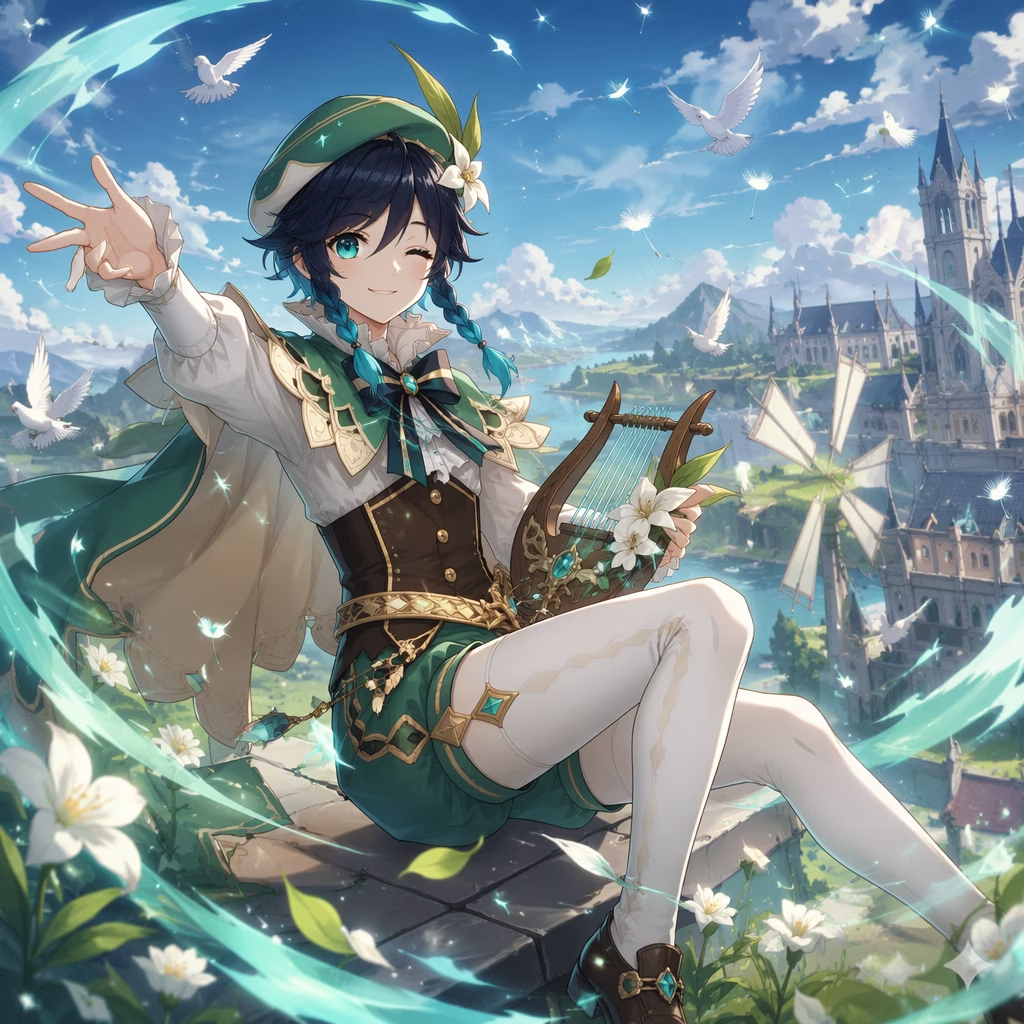
It is not unusual to see grand recreations in Minecraft servers; the game is a cathedral where the pious come to carve their devotion into cubic altars. Yet, projects like these—complete, faithful, and forged at a true 1:1 scale—are a different creature altogether. They are the ivory-billed woodpeckers of the building world: often glimpsed as grand plans, seldom proven real. The German collective known as the Skyblock Squad did not merely plan. They labored. Over four hundred hours, a span of time that could have birthed a novel or traversed a continent, they poured into the silent geometry of Mondstadt’s walls. And just as a master tailor adjusts a pattern to an unfamiliar cloth, they wrestled with the stubborn proportions of Minecraft’s meter-long blocks, stretching the city’s dimensions until the very act of scaling became an art form.
The process, as they shared in their quiet documentation, was a dance of fractions. Because the fundamental unit of Minecraft is a cube of fixed size, the graceful arches of the Mondstadt Cathedral, the cozy intimacy of Angel’s Share tavern, the towering dignity of the Knights of Favonius Headquarters—each demanded reinterpretation. What emerged from that tension is a Mondstadt slightly larger than the one we know from Genshin Impact, a giant made gentle, breathing with its own rhythm. It reminds me of what happens when you fold a paper crane from a sheet too thick: the bird survives, but its wings carry a new, endearing heaviness. The Skyblock Squad’s Mondstadt is exactly that: a beloved shape that has learned to wear its blocky skin without apology.
But a city is more than its silhouette. To walk through Mondstadt in Genshin Impact is to slip in and out of buildings as easily as a thought passes through a mind, and the builders understood this with a reverence that borders on the sacred. Every interior that was accessible in the game—the cathedral’s stained-glass solemnity, Diluc’s bar where secrets are traded like vintage wine, the headquarters where Jean’s devotion hangs in the air like a constant, quiet hum—was brought to life inside their Minecraft reconstruction. Standing inside that digital double, I imagine, must feel like being a child again, opening a dollhouse to find the tiny fire still burning in the hearth. It’s the completeness that stills the breath: the sense that no corner was deemed too small to love.
Time has a way of accelerating in the world of live-service games. We are, at this moment in 2026, far beyond the version 2.4 that framed the Skyblock Squad’s original labor. Enkanomiya has long since yielded its abyssal secrets, the Sumeru rainforests have watched their saplings grow ancient, and Fontaine’s waters have risen and receded in our collective memory. But Mondstadt endures as a fixed star—the first region, the first city, the first home. And in a parallel universe rendered entirely in blocks, that home now stands as a monument, immune to the patch cycles and server updates that might otherwise erase it. It’s a kind of immortality achieved not through code, but through countless right-clicks and painstaking removal of misplaced cobblestone.
The builders themselves have shared a time-lapse record of this journey, a video that compresses four hundred hours into a few minutes of frantic, purposeful motion. Watching it is like staring at a meadow through a centuries-spanning lens: figures dart like industrious ants, walls rise as if exhaled by the earth, and the cathedral spire pushes toward the blocky sky with the slow inevitability of a stalagmite reaching for the cavern roof. It’s humbling. It’s the sort of thing that makes you proud to be a player, to belong to a community where such obsession can be transformed into a gift offered freely to anyone with an IP address and a sense of wonder.
I find myself thinking about the silent language that flows between games. Genshin Impact and Minecraft could hardly be more different in their textures—one a polished, anime-brushed panorama, the other a sparse world of frugal beauty—and yet the Skyblock Squad has proven that the soul of a place can survive translation if the translator is patient enough. The Mondstadt that now exists on their server is a living argument that creativity is not bound by graphical fidelity, that a windmilling thought can catch the same breeze whether it’s made of polygons or blocks. In an era when graphics cards can simulate individual droplets of rain, these creators opted to build with the most basic of shapes, and in doing so, they reminded us that wonder has never needed high resolution.
When I log into Minecraft today, in the quiet hum of a 2026 evening, I sometimes download their world file and simply stroll. I walk past the fountain where a thousand idle conversations once bloomed in another realm. I stand beneath the statue of Barbatos and recall that freedom is not a place but a condition of the spirit—and that here, in this impossible architecture, freedom has been given a second address. The Skyblock Squad’s Mondstadt is more than a replica; it is a love letter written in a dozen different types of stone, signed by hands that will never shake yours, yet manage to hold yours all the same.
So if you ever find yourself feeling that the worlds we love are fleeting, that servers will eventually go dark and save files will corrupt, remember that a group of builders armed with nothing but patience and pickaxes built a city to outlast memory. They built it in a game where the sun always rises square and the rain makes the same sound against every roof, and they filled it with enough passion to make even the pixels weep. That, to me, is the truest kind of magic: the kind that doesn’t ask for your credit card, only your willingness to believe that a thousand small acts of devotion can call forth a world.
Comments